Research
Deep example of a selected project
dsGrid: Personalized brain stimulation targeting without an fMRI scan
The problem
Transcranial magnetic stimulation (TMS) uses magnetic pulses to noninvasively change brain activity, but its effects vary a lot between people. One reason is that stimulation sites are often picked using scalp landmarks or group-average brain maps, which ignore individual differences in brain organization. Personalized fMRI-guided targeting is more precise, but it’s expensive, slow, and requires specialized expertise, so many labs and clinics can’t use it.
The approach
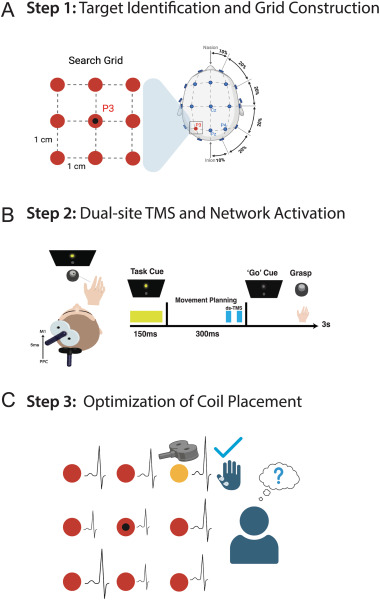
dsGrid is a scalable alternative that uses the brain’s own physiological response to find each person’s target. It works in three steps:
- Build a search grid on the scalp around a conventional starting point (the P3 electrode position), with 1 cm spacing.
- Probe each grid point with two TMS coils during a grasping task. One pulse over posterior parietal cortex is followed 5 ms later by a pulse over motor cortex, and the resulting muscle response (motor evoked potential, MEP) reflects how strongly the two regions are connected.
- Pick the hotspot where the response is largest, confirmed with a rule-based procedure (the response had to exceed 1.2 mV in at least 3 of 5 consecutive trials).
The question I tested
Does the dsGrid target actually sit at a better location than the standard P3 target? To check this against an independent measure, I compared both sites using three types of fMRI data from the same people.
Data
| Participants | 47 healthy adults (32 female, ages 18-50) |
| Visits | One MRI session, one dual-coil TMS session |
| MRI | 3T scanner, structural scan, 8 min resting-state fMRI, 20 min task fMRI (visuomotor force-tracking task) |
| TMS | Dual-site TMS, neuronavigation, EMG recorded from hand muscles |
Analysis
- Preprocessing: fMRIPrep, then ciftify to project data onto each person’s cortical surface (fsLR 32k), so results account for individual anatomy.
- Connectivity: Band-pass filtering and a 36-regressor confound model (head motion, global signals, derivatives, quadratic terms, plus spike regressors) in Python (nilearn). For task data, I regressed out task-evoked activity with an FIR model to avoid inflating connectivity estimates.
- Task activation: A conventional GLM with autoregressive noise modeling.
- Statistics: Linear mixed-effects models in R (lme4) with target site as a fixed effect and subject as a random effect, tested with Type II Wald F tests and Kenward-Roger degrees of freedom. A regression tested whether the distance between dsGrid and P3 targets predicted the size of the advantage. Distances were computed along the cortical surface with Connectome Workbench.
Results
dsGrid targets showed stronger connection to the motor hand region and more task-relevant activity than the standard P3 target on all three fMRI measures:
| Measure | Result | Effect size (partial η²) |
|---|---|---|
| Resting-state connectivity | F(1,46) = 5.72, p = 0.02 | 0.11 |
| Task-based connectivity | F(1,46) = 13.13, p < 0.001 | 0.22 |
| Task-evoked BOLD activity | F(1,46) = 4.89, p = 0.03 | 0.10 |
The advantage also wasn’t uniform, and that variation was informative. For some people the dsGrid target landed right next to P3, with little difference. For others it landed far away, which suggests P3 would have been a poor choice for them. Distance from P3 explained a large share of the variation in the advantage (adjusted R² = 0.42 for resting-state and 0.49 for task-based connectivity, both p < 0.001).
Why it matters
dsGrid personalizes targeting using only equipment many TMS labs already have, which makes individualized stimulation more accessible for research and potentially for clinical use. The main limitations: the sample was young and healthy, and the method currently relies on a measurable physiological readout (like MEPs), so it needs validation in older adults and clinical populations.
My role
First author. I led the fMRI preprocessing and connectivity pipeline, ran the statistical analysis, and wrote the original draft of the manuscript. Data collection and study design were shared across the team (see paper for the full author contributions).